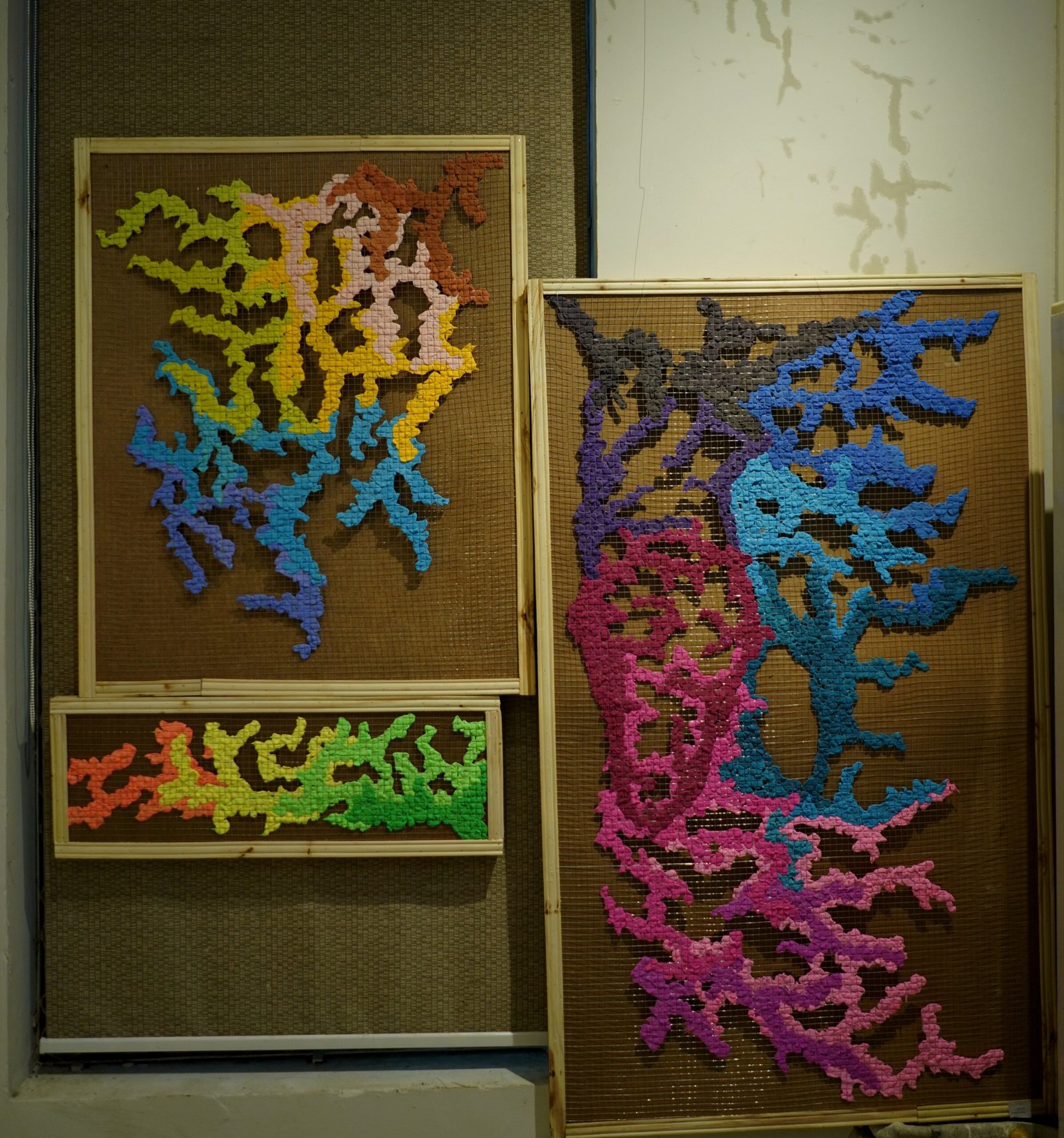
Ayesha Afzal is a solipsistic person and this has been exquisitely explained through her work. The work of clay that is delicate to be handled on the mesh echoes transition of self-awareness to self-obsession which is a psychological growth. Her work draws a fine line between narcissism and self-reflection which leads to self-love. Self-obsession is not to be bewildered with vanity of being egoistic but it is embracing yourself with all the flaws and un-judged appreciation. It’s a human nature to explore himself but when this phenomena moves beyond the limit, it silent the societal voices and roar the internal thoughts. Ayesha connects the inner self obsession with the world on a broader level. This artwork is unpacking the mixed concept of self-obsession and self-awareness.
Ayesha translates abstract psychological state into tangible form through two materials i.e. wire mesh and clay. Some art work is 2D and some are even 3D cylindrical structures to supervise self-obsession with arms akimbo and give voice to inner self. The spaces these dimensional structures are occupying show how the obsessive thoughts dominate one’s mental space. The viewer must have to pass around these structures, analyzing patches of clay which replicates emerging through self-perception. Wire mesh symbolizes boundary for self-perception while clay symbolizes flexibility of evolving thoughts and transforming physical state of self. The antagonism between rigid wire mesh and pliant nature of clay reflects the tussle between self-reflection and chaotic self-obsession. Clay pasted directly on the mesh creates heavy structure of psychological growth. The pliable nature of clay requires labor to be molded so as the thoughts of self-awareness to self-obsession. As wire mesh allows air and light to pass through it, it shows how vulnerable our boundaries are to external observation. When earthy clay is pressed against the rigid mesh, it metaphors how thoughts of self-obsession spills over the edge of self-awareness.
Color theory has also been instrumental that deep greens are contrasted with blues, pinks, and warm yellows to give bewitched visual adventure. The universal peacock contrast describes the updating perception about self-obsession. The conflicting hues give two lenses to analyses ourselves. One is how WE perceive ourselves vs. how SOCIETY observes us. Her work demonstrates that when we work on self-awareness and do self-reflection, there is transition to self-obsession but it should be controlled before it evolves into narcissism which is evil side of self-obsession. Her illustrations provoke to examine ourselves through nonjudgmental lens. When a person is so much focused in catechizing himself, he neglects the external reality. This artwork captures the subtle balance between scanning oneself and not being trapped in owns mind. Her color theory describes the shifting moods of obsession. The changing of colors from dark at the top to the vibrant ones shows that how a heavy cloud of thought can turn into active attracting state. This artwork is a qualitative psychological inquiry in which Ayesha uses her self-examining experience as a primary source to show her creativity for decoding human experience.
This clockwork is in asymmetrical panels which show mutation of thoughts which does not follow any uniformity, but it is a fragmentation because inner voices are oblique. It halts the destructive nature of obsession before it becomes narcissism. Self-reflection, when processed, analyzed, expressed and transformed, it cradles self-love which involves acceptance with all flaws and a vow to work on the personality gaps to have personal growth. By sculpting internal chaos into artistic form, Ayesha has not only vocalized her own mind, but also opens the door of self-perception for audience. Her artwork fosters metamorphosis.
Written by Hafiza Ayesha Mumtaz Alvi
Ayesha has recently completed her Bachelors of Studies in English from the National University Of Modern Languages. She is currently a faculty member at Adabistan-e-Soophia in Lahore. She likes to write fiction that pulls her reader away from reality and into worlds of fantasy.
About the Artist: Ayesha Afzal is a visual artist and recent graduate of Rawalpindi Women University. She is primarily working with sculptures and immersive installations that combine geometric structures of wire mesh with organic forms and vibrant tonal variations. Her work is rooted in the human quest to understand the self.
Image: شہ سرخیاں, Ayesha Afzal, installation, all copyrights are retained by the artist, 2026.